Choosing the right cuvette can influence every absorbance value, baseline, and calibration decision. An Optical Fused Quartz Spectrophotometer Cuvette supports demanding ultraviolet and visible measurements. Its low-iron fused quartz body commonly transmits ultraviolet light from approximately 190 nanometers, depending on grade and surface quality.
ASTM E275 provides guidance for evaluating ultraviolet-visible spectrophotometer performance, including photometric accuracy and stray-light effects. USP General Chapter <857> also emphasizes instrument suitability for analytical measurements. These standards do not make every cuvette equivalent. Wall thickness, optical polishing, path-length tolerance, cleanliness, and chemical compatibility still require careful inspection. A tiny fingerprint near the 10-millimeter optical window can alter results. It happens more often than many laboratories admit.
Market analyses from Grand View Research and MarketsandMarkets describe steady growth in spectroscopy applications across pharmaceutical, environmental, food, and academic laboratories. Their forecasts vary by scope, region, and base year. That variation deserves attention. It reminds buyers to compare technical performance, not only market popularity. The following Top 10 selection examines fused quartz cuvettes through practical laboratory criteria, including wavelength range, dimensional consistency, sample volume, packaging, and documentation. Experience suggests that the most expensive option is not always the most reliable. A carefully matched cuvette, verified against the instrument and method, often performs better than a premium product chosen without evidence. Each candidate therefore deserves a closer question: does it deliver stable optical contact under real working conditions?
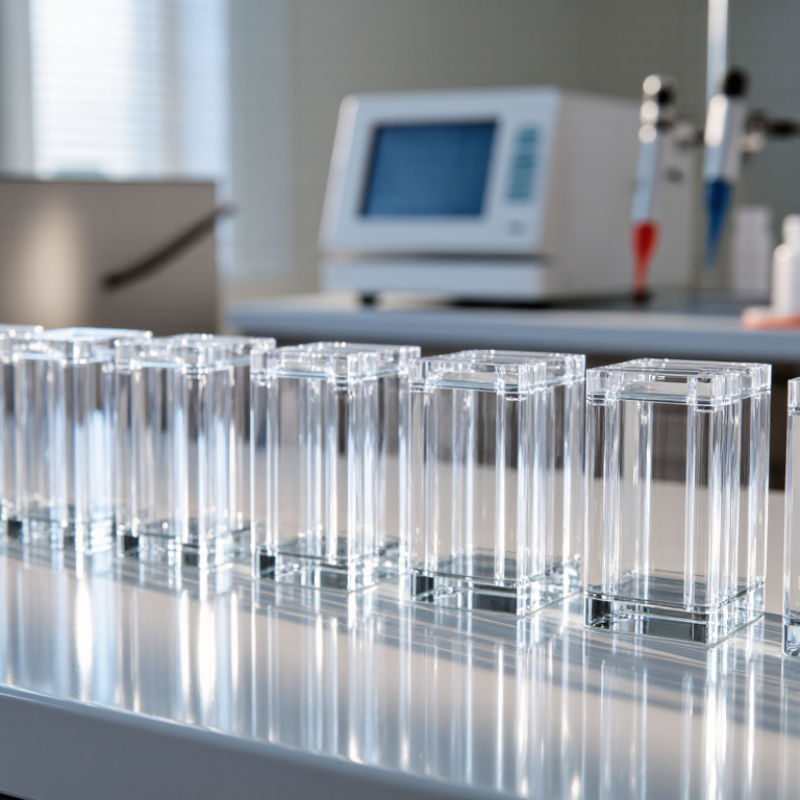
Optical Fused Quartz Spectrophotometer Cuvettes: Definition and Key Features
Top 10 Optical Fused Quartz Spectrophotometer Cuvettes
Optical fused quartz cuvettes are transparent sample cells made from high-purity silica glass. They support ultraviolet and visible measurements better than ordinary glass. Many fused quartz grades transmit near 190 nanometers, although the exact limit depends on purity, surface quality, and wall thickness. Their low fluorescence and strong chemical resistance suit DNA, protein, and solvent analysis. A 2024 Grand View Research assessment reported steady growth in the UV-Vis spectroscopy market, reflecting broader demand for reliable sampling accessories.
When comparing the top 10 cuvettes, check more than material claims. Important features include a controlled optical path length, low absorbance, polished windows, dimensional consistency, and solvent compatibility. ASTM E275 emphasizes wavelength accuracy and photometric performance in spectrophotometric practice. ISO/IEC 17025 also supports documented calibration and measurement control. In real laboratory use, fingerprints, tiny bubbles, or a slightly tilted cuvette can distort results. I have found cleaning discipline more important than impressive packaging. This point is easy to underestimate.
Tips: Match cuvettes as a pair for comparative testing. Rinse with the test solvent, not tap water. Inspect each window under angled light. Use the same orientation every time. A 10-millimeter path length remains common, but microvolume cells may reduce sample waste. Do not assume every quartz cell reaches deep UV wavelengths. Review the supplier’s transmission curve, tolerance data, and cleaning guidance before purchase. Even experienced users should question one perfect-looking result.
Top 10 Optical Fused Quartz Spectrophotometer Cuvettes - Optical Fused Quartz Spectrophotometer Cuvettes: Definition and Key Features
Optical fused quartz spectrophotometer cuvettes are precision sample cells made from UV-transparent fused silica. The specifications below represent common laboratory configurations; actual dimensions, tolerances, and working volumes may vary by manufacturer.
| Rank | Cuvette Configuration | Typical Optical Path | Typical Working Volume | Typical Wavelength Range | Window Geometry | Key Features | Recommended Application |
|---|---|---|---|---|---|---|---|
| 1 | Standard Macro Quartz Cuvette | 10 mm | 2.5–4.5 mL | Approximately 190–2,500 nm | Two polished optical windows; clear or frosted side walls | General-purpose format, compatible with most standard spectrophotometer holders, good optical uniformity | Routine UV-Vis absorbance measurements and calibration work |
| 2 | Semi-Micro Quartz Cuvette | 10 mm | 0.7–1.5 mL | Approximately 190–2,500 nm | Reduced aperture with two optical windows | Uses less sample than macro cells while retaining a standard 10 mm path length | Protein assays, nucleic-acid analysis, and limited-volume laboratory samples |
| 3 | Micro Quartz Cuvette | 10 mm | 70–500 µL | Approximately 190–2,500 nm | Small central aperture; optical windows aligned with the beam | Low sample consumption, requires accurate positioning and sufficient liquid height | Precious, concentrated, or low-volume biological and chemical samples |
| 4 | Ultra-Micro Quartz Cuvette | 1–10 mm | 2–100 µL | Approximately 190–2,500 nm | Very small optical channel, often with a specialized holder | Designed for extremely small samples; path length may be fixed or adjustable | High-value samples, microfluidic workflows, and low-volume spectral screening |
| 5 | Quartz Cuvette with PTFE Stopper | 10 mm | 2.0–4.0 mL | Approximately 190–2,500 nm | Two optical windows with chemical-resistant closure | Helps reduce evaporation, contamination, and accidental spillage during measurement | Volatile solvents, oxygen-sensitive samples, and repeated measurements |
| 6 | Screw-Cap Quartz Cuvette | 10 mm | 1.5–3.5 mL | Approximately 190–2,500 nm | Two optical windows with threaded cap and seal | Secure closure, improved sample containment, and suitability for mixing or transport | Air-sensitive, volatile, or transport-sensitive liquid samples |
| 7 | Four-Window Quartz Cuvette | 10 mm | 2.0–4.0 mL | Approximately 190–2,500 nm | Optical windows on four sides | Allows multiple beam orientations and is useful where side illumination is required | Fluorescence, polarization, anisotropy, and specialized optical measurements |
| 8 | Quartz Flow-Through Cuvette | 10 mm | 0.2–1.5 mL internal volume | Approximately 190–2,500 nm | Optical windows with inlet and outlet ports | Supports continuous sampling, automation, and reduced handling between measurements | Process monitoring, chromatography, kinetics, and automated analysis |
| 9 | Long-Path Quartz Cuvette | 20–100 mm | 5–35 mL | Approximately 190–2,500 nm | Extended optical channel with polished end windows | Increases absorbance for dilute samples; requires compatible long-path instrumentation | Trace analysis, dilute solutions, and environmental measurements |
| 10 | Demountable Quartz Cuvette | 1–10 mm, interchangeable | 0.1–3.0 mL | Approximately 190–2,500 nm | Removable optical windows with a replaceable spacer or gasket | Adjustable path length, easier cleaning, and suitability for viscous or difficult samples | Research methods requiring path-length optimization or specialized sample handling |
FAQS
Fused quartz transmits ultraviolet light more reliably than ordinary optical glass. It commonly supports measurements from about 190 nanometers upward. Check the required lower wavelength limit. Appearance alone proves little.
A 10 mm path length suits many routine tests. Use 5 mm or 2 mm paths for concentrated samples. Longer paths improve weak-signal sensitivity. They can also increase noise and alignment demands.
Choose one when the available sample volume is very small. It conserves valuable liquid. Pipetting must be steady and precise. Even a small bubble can distort the reading.
Often, yes. Four polished windows allow flexible excitation and emission directions. They can simplify instrument orientation. Confirm the holder geometry before ordering.
Hold each cuvette by its frosted sides. Never touch the clear optical windows. Fingerprints can leave films and cause absorbance errors. Especially below 250 nanometers.
Rinse the cuvette immediately with a compatible solvent. Then wash it with mild laboratory detergent and purified water. Avoid abrasive brushes, metal tools, and harsh alkaline baths. Dry it in a lint-free holder.
Hold it under bright, angled light. Look for haze, scratches, droplets, and rainbow-like films. Inspect every optical window. Tiny marks matter.
Store them upright in separate protective slots. Keep the optical faces from touching. Use a dry, dust-free storage box. Do not leave them loose in a drawer.
Yes. Temperature, bubbles, filling height, and meniscus shape can affect measurements. Use a blank scan after cleaning. Repeat unusually clean or unstable results. I would not assume the instrument is always responsible.
Conclusion
Optical Fused Quartz Spectrophotometer Cuvettes are precision laboratory vessels designed for accurate transmission measurements across ultraviolet, visible, and near-infrared wavelengths. This article explains their construction, high optical clarity, chemical resistance, thermal stability, and low absorption characteristics. It also introduces practical methods for evaluating cuvette quality, including transparency, surface finish, dimensional consistency, path-length accuracy, and optical precision. A comparison of ten representative cuvette types highlights differences in design, capacity, path length, and suitability for various spectrophotometric tasks.
The guide further explains how to select the most appropriate cuvette for routine measurements, low-volume samples, broad spectral analysis, or demanding ultraviolet applications. To maintain reliable performance, users will learn proper handling techniques, including holding cuvettes by the frosted sides, avoiding scratches and contamination, using compatible cleaning solutions, rinsing thoroughly, and storing them in protective conditions. These practices help preserve measurement accuracy, extend service life, and ensure consistent experimental results.