Blog

Top Capillary Fused Quartz Chromatography Tube Suppliers
Selecting reliable Capillary Fused Quartz Chromatography Tube suppliers requires more than comparing prices or catalog photographs. These tubes support precise separations in gas chromatography, where internal diameter, wall thickness, surface activity, and thermal stability can affect peak shape and reproducibility. Small defects matter. A rough inner surface may create adsorption, tailing, or inconsistent retention times.
Industry reports show why supplier evaluation remains important. The MarketsandMarkets Chromatography Market report identifies pharmaceutical analysis, food testing, and environmental monitoring as major growth areas. Grand View Research also reports continuing investment in chromatography instruments and laboratory automation. These trends increase demand for dependable quartz components, but market growth does not guarantee equal manufacturing quality. Specifications can look impressive while batch consistency remains unclear.
This guide examines leading suppliers through practical criteria, including fused silica purity, dimensional tolerance, temperature resistance, surface deactivation, packaging, and certificate availability. ISO 9001 certification can support process control, but it should not replace technical verification. Buyers should request inspection data, lot traceability, and compatibility details for their instruments. A capable supplier should explain how tubes are drawn, cleaned, inspected, and protected from contamination.
The comparison is not absolute. Supplier performance may change by region, product grade, and order volume. Some vendors publish detailed tolerances; others provide limited information. That gap deserves attention. In real laboratory work, a slightly higher purchase price may reduce column failures, reruns, and wasted samples. The best choice is therefore the supplier that combines documented quality with responsive technical support and stable delivery.
Read more »
 By:Seraphina Grace
- October 26, 2026

Top 10 Optical Fused Quartz Spectrophotometer Cuvettes
Choosing the right cuvette can influence every absorbance value, baseline, and calibration decision. An Optical Fused Quartz Spectrophotometer Cuvette supports demanding ultraviolet and visible measurements. Its low-iron fused quartz body commonly transmits ultraviolet light from approximately 190 nanometers, depending on grade and surface quality.
ASTM E275 provides guidance for evaluating ultraviolet-visible spectrophotometer performance, including photometric accuracy and stray-light effects. USP General Chapter also emphasizes instrument suitability for analytical measurements. These standards do not make every cuvette equivalent. Wall thickness, optical polishing, path-length tolerance, cleanliness, and chemical compatibility still require careful inspection. A tiny fingerprint near the 10-millimeter optical window can alter results. It happens more often than many laboratories admit.
Market analyses from Grand View Research and MarketsandMarkets describe steady growth in spectroscopy applications across pharmaceutical, environmental, food, and academic laboratories. Their forecasts vary by scope, region, and base year. That variation deserves attention. It reminds buyers to compare technical performance, not only market popularity. The following Top 10 selection examines fused quartz cuvettes through practical laboratory criteria, including wavelength range, dimensional consistency, sample volume, packaging, and documentation. Experience suggests that the most expensive option is not always the most reliable. A carefully matched cuvette, verified against the instrument and method, often performs better than a premium product chosen without evidence. Each candidate therefore deserves a closer question: does it deliver stable optical contact under real working conditions?
Read more »
 By:Ethan Carter
- October 22, 2026
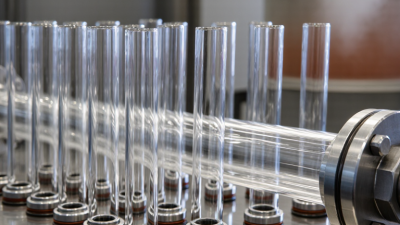
Top 10 High Pressure Quartz Sight Glass Tubes
Selecting the right High-Pressure Quartz Sight Glass Tube requires more than comparing pressure ratings. It demands attention to temperature, chemical exposure, wall thickness, sealing methods, and optical clarity. In a process line, a small tube may sit beside a hot reactor, flashing liquid, or abrasive gas. Its surface must remain readable, stable, and resistant to sudden thermal stress.
Dr. James E. Shelby, a recognized glass-science author, has emphasized, “The properties of glass depend strongly on its thermal history.” That principle matters here. Poorly controlled heating or cooling can create internal stress, even when the tube looks flawless. Appearance can mislead.
This Top 10 guide examines quartz sight glass tubes through practical operating details. It considers pressure performance, ultraviolet transmission, thermal shock resistance, dimensional consistency, and connection reliability. Each factor affects what operators actually see through the tube. A cloudy surface can hide contamination. A weak seal can cause leakage. An oversized design may add cost without improving safety.
Real applications are rarely perfect. Installation errors happen. Maintenance schedules slip. Some specifications remain incomplete. Therefore, the best choice is not always the most expensive tube. It is the tube whose verified properties match the process conditions, including unexpected temperature changes and repeated cleaning cycles. Readers should confirm supplier data, testing records, and engineering limits before installation. That step feels obvious. It is still missed too often.
Read more »
By:Ethan Carter
- October 22, 2026

Top Semiconductor Photomask Quartz Plate Suppliers
Top Semiconductor Photomask Quartz Plate Suppliers
Choosing among top Semiconductor Photomask Quartz Plate suppliers requires more than comparing prices. Quartz plates support photomask stability, optical transmission, and dimensional accuracy during advanced lithography. Even tiny particles, scratches, or residual stress can affect pattern fidelity. The risk becomes sharper as feature sizes shrink.
Chris A. Mack, a respected lithography expert, explains, “Lithography is the process of printing patterns on a substrate.” His statement highlights the photomask’s role as a precise pattern-transfer tool. A quartz plate is not merely transparent glass. It must provide low defect density, controlled flatness, excellent surface quality, and reliable thermal behavior. These details become visible under inspection lights, where a faint haze or edge chip may signal deeper process weakness.
Experience matters here. Qualified suppliers usually document synthetic quartz grades, cleaning procedures, inspection methods, and batch traceability. They should also communicate tolerances clearly. Ask about polishing equipment, particle monitoring, laser or optical inspection, and packaging discipline. Do not accept vague claims.
No supplier is perfect.
A strong comparison should examine actual samples, not only brochures. Measure flatness, surface roughness, transmission, and dimensional consistency against project specifications. Manufacturing capacity also matters, especially when pilot orders become recurring production. Delivery records, corrective-action reports, and technical support reveal operational maturity. Some vendors may offer attractive lead times but lack stable quality between batches. That weakness is easy to miss.
This guide reviews leading suppliers through technical capability, quality evidence, customization, responsiveness, and long-term reliability. The evaluation remains practical, because laboratory performance and factory consistency do not always match. A careful buyer should verify both.
Read more »
By:Ethan Carter
- October 22, 2026